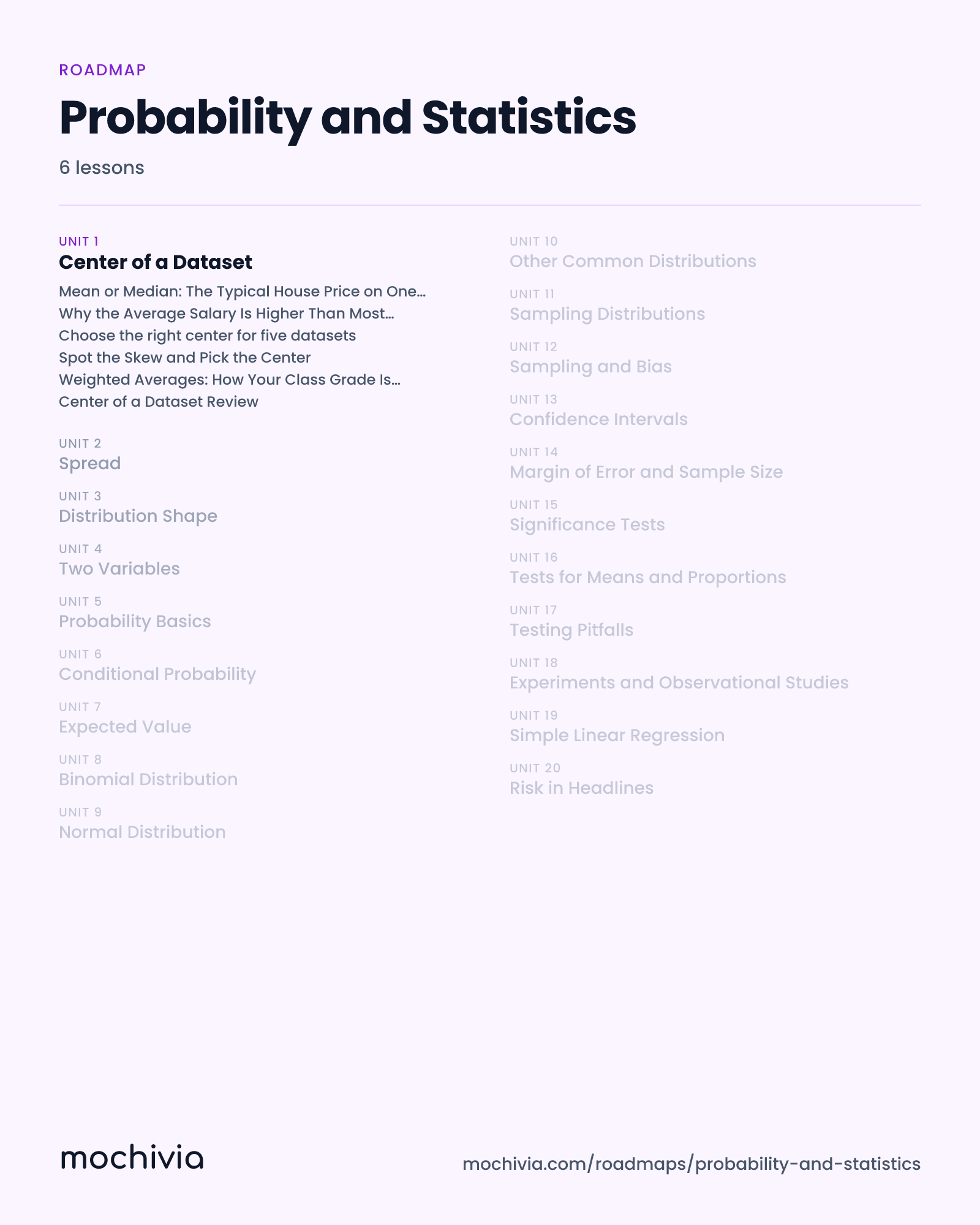
Probability and Statistics
6 lessons

Scan on iPhone
What you'll learn

Unit 1
Center of a Dataset
6 lessons
- Mean or Median: The Typical House Price on One Street
- Why the Average Salary Is Higher Than Most Paychecks
- Choose the right center for five datasetsExercise
- Spot the Skew and Pick the CenterChallenge
- Weighted Averages: How Your Class Grade Is Really Calculated
- Center of a Dataset ReviewUnit review
Unit 2
Spread
Unit 3
Distribution Shape
Unit 4
Two Variables
Unit 5
Probability Basics
Unit 6
Conditional Probability
Unit 7
Expected Value
Unit 8
Binomial Distribution
Unit 9
Normal Distribution
Unit 10
Other Common Distributions
Unit 11
Sampling Distributions
Unit 12
Sampling and Bias
Unit 13
Confidence Intervals
Unit 14
Margin of Error and Sample Size
Unit 15
Significance Tests
Unit 16
Tests for Means and Proportions
Unit 17
Testing Pitfalls
Unit 18
Experiments and Observational Studies
Unit 19
Simple Linear Regression
Unit 20
Risk in Headlines
Explore more roadmaps
Law
Legal literacy — how law actually works. The trunk gives you the operating system: where law comes from, how courts and precedent work, contracts, torts, property, criminal vs civil, and constitutional structure. Clusters dive into reading cases, contract mechanics, IP, your rights with police, and the startup legal toolkit.
Databases
Build the universal mental model that every database is implemented against — the relational model, schemas and keys, indexes, transactions, concurrency, PostgreSQL architecture, production operations, modeling patterns, and the modern data ecosystem (NoSQL, distributed SQL, warehouses, vectors, streaming).
Machine Learning
How machine learning actually works — from learning-as-optimization through the classical toolkit to deep learning and foundation models. The depth step after AI Fundamentals: real mechanics, no code or graduate math required.
Leveraging AI
A beginner-friendly curriculum that builds deep intuition for how AI actually works — not through math or code, but through mental models that make effective use a natural consequence of understanding. Covers how language models think, why they hallucinate, the art of prompting, practical AI workflows for writing, images, and code, and the societal shifts AI is driving. Designed for anyone curious enough to want more than tips and tricks.
About 30 hours
Mathematics
A working understanding of mathematics — the universal language scientists, engineers, and quants use to describe the world. The trunk gives you the throughline from how mathematicians think to how math models reality; clusters dive into proof, trig, calculus mechanics, advanced linear algebra, number theory and cryptography, probability, stochastic processes, and the foundational limits of math itself.
Sales
A working understanding of the craft of selling — buyer psychology, discovery, qualification, objection handling, negotiation, and pipeline math. The trunk walks one complete deal motion from prospect to close to expansion; clusters dive into outbound mechanics, discovery frameworks, objection playbooks, negotiation, founder-led sales, and enterprise deals.
Frequently asked questions
What does the Probability and Statistics roadmap cover?
1 unit: Center of a Dataset.
How do I start the Probability and Statistics roadmap?
Get the Mochivia app on the App Store and open this roadmap there.
Start Probability and Statistics
Scan on iPhone