Based on the role AI Product Manager
Leveraging AI
A beginner-friendly curriculum that builds deep intuition for how AI actually works — not through math or code, but through mental models that make effective use a natural consequence of understanding. Covers how language models think, why they hallucinate, the art of prompting, practical AI workflows for writing, images, and code, and the societal shifts AI is driving. Designed for anyone curious enough to want more than tips and tricks.
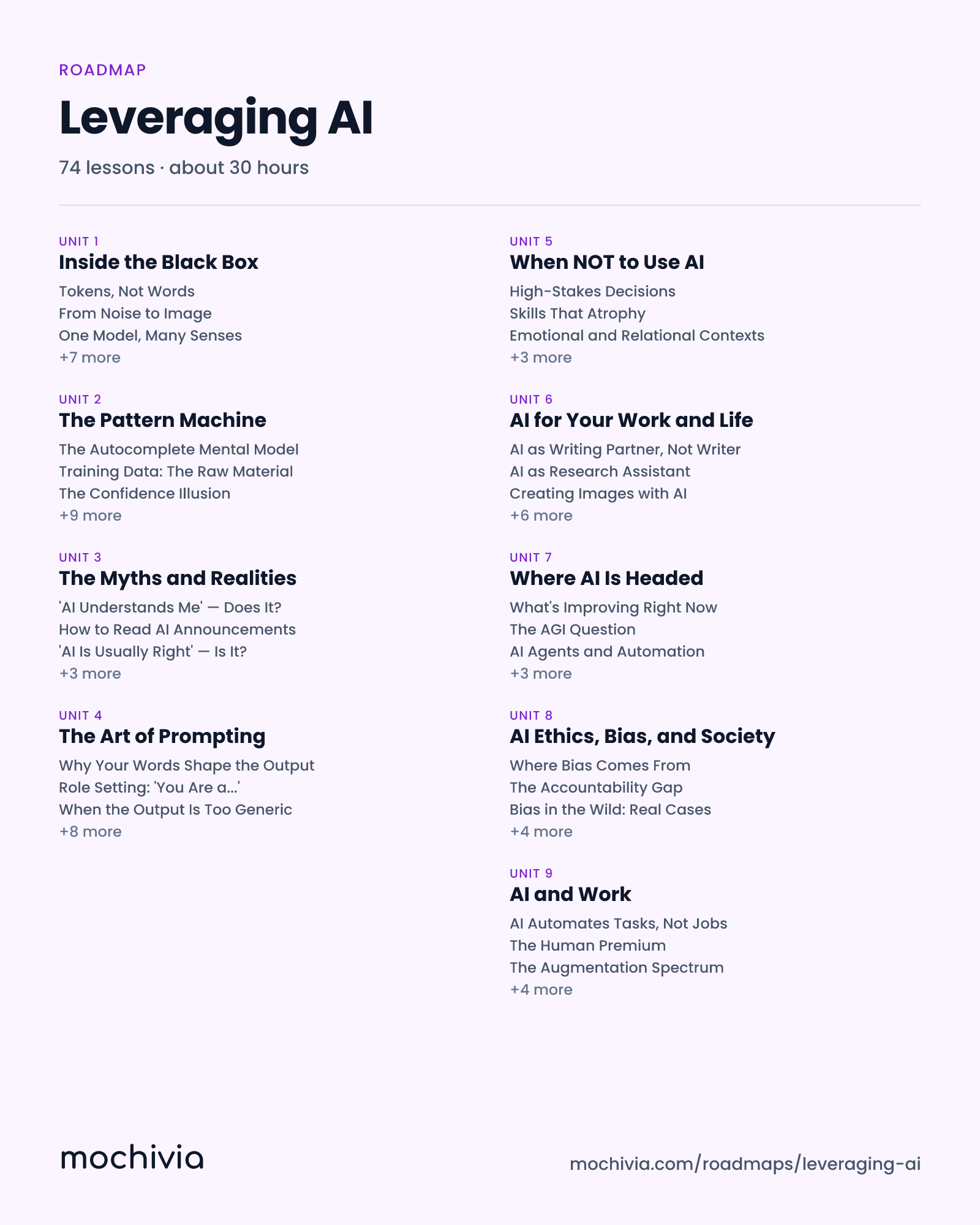
74 lessons · about 30 hours

What you'll learn
How AI Thinks
Build a working mental model of what AI actually does under the hood — no math required. You'll understand why language models can write poetry but can't count, why they hallucinate with confidence, and what 'training' really means. This pillar replaces vague intuitions with clear, accurate mental pictures.
Unit 1
Inside the Black Box
Peek under the hood of AI without a single equation. This course uses analogies and visual mental models to explain how language models process text, how image generators turn words into pictures, and how multimodal AI combines different senses. You won't become an engineer, but you'll develop intuition that makes you a dramatically better user.
10 lessons
- Tokens, Not Words
- From Noise to Image
- One Model, Many Senses
- The Attention Spotlight
- How Text Guides Pixels
- Voice AI: How Machines Speak and Listen
- The Context Window
- Why AI Art Has Tells
- AI Agents: Combining Abilities
- One Token at a Time
Unit 2
The Pattern Machine
What is AI actually doing when it 'thinks'? This course builds the foundational mental model: AI is a pattern machine, not a reasoning engine. You'll understand the difference between pattern matching and genuine understanding, why this distinction matters for everything you'll ever do with AI, and what it means that AI learned from the internet.
12 lessons
- The Autocomplete Mental Model
- Training Data: The Raw Material
- The Confidence Illusion
- Patterns All the Way Down
- The Training Game
- Why AI Hallucinates
- AI vs. Human Intelligence
- What the Model Actually Stores
- The Knowledge Cutoff Problem
- The Zoo of AI Models
- Scale: The Surprising Ingredient
- Strong Patterns, Weak Reasoning
Unit 3
The Myths and Realities
AI is surrounded by myths — some overblown fears, some overhyped promises. This course takes the mental models from earlier courses and applies them to systematically bust the most common misconceptions. You'll develop a calibrated sense of what AI actually can and cannot do today.
6 lessons
- 'AI Understands Me' — Does It?
- How to Read AI Announcements
- 'AI Is Usually Right' — Is It?
- Benchmarks vs. the Real World
- 'AI Will Replace Everyone' — Will It?
- The Demo vs. Daily Driver Gap
Using AI Effectively
Turn your understanding of how AI thinks into practical skill. This pillar covers the art and science of prompting, AI-powered workflows for writing, images, code, and research, strategies for building AI into your daily work, and the critical judgment of knowing when not to use AI at all.
Unit 4
The Art of Prompting
Prompting is not about magic phrases — it's about communicating clearly with a pattern machine. This course teaches prompting from first principles: why certain techniques work (grounded in the mental models from Pillar 1), how to structure prompts for different tasks, and how to iterate when results aren't right. You'll develop intuition, not just recipes.
11 lessons
- Why Your Words Shape the Output
- Role Setting: 'You Are a...'
- When the Output Is Too Generic
- The Specificity Spectrum
- Chain of Thought: 'Think Step by Step'
- When the Output Is Factually Wrong
- Context Is Everything
- Few-Shot Examples: 'Like This'
- When the Output Misses the Point
- The Instruction-Format Connection
- Iterative Refinement: The Conversation Loop
Unit 5
When NOT to Use AI
Knowing when to use AI is a skill. Knowing when NOT to use it is wisdom. This course covers the domains where AI is unreliable, the situations where AI use is risky or unethical, and the human skills that atrophy if you outsource them to machines. Effective AI users aren't the ones who use AI for everything — they're the ones who know where the line is.
6 lessons
- High-Stakes Decisions
- Skills That Atrophy
- Emotional and Relational Contexts
- Privacy and Data Exposure
- Novel and Creative Thinking
- The 'Use It or Skip It' Framework
Unit 6
AI for Your Work and Life
A practical tour of AI applications across writing, research, images, code, and daily productivity. For each domain, you'll learn what AI does well, what it does poorly, and how to build workflows that play to its strengths. This isn't a tool tutorial — it's a framework for thinking about AI assistance that works regardless of which specific product you use.
9 lessons
- AI as Writing Partner, Not Writer
- AI as Research Assistant
- Creating Images with AI
- Drafting and Editing Workflows
- Learning Anything with AI
- AI for Code — Even If You Don't Code
- Emails and Professional Communication
- AI for Data and Analysis
- Building Your AI Toolkit
AI & the World
Zoom out from personal use to the big picture. How is AI reshaping work, amplifying bias, challenging regulation, and redefining what it means to be human in an age of intelligent machines? This pillar equips you to think clearly about AI's societal impact and build your own informed position.
Unit 7
Where AI Is Headed
The final course turns your accumulated understanding toward the future. Not predictions — because nobody knows the future of AI — but a framework for thinking about what's coming, what's plausible, and what's hype. You'll develop the mental tools to keep learning as AI evolves long after this curriculum ends.
6 lessons
- What's Improving Right Now
- The AGI Question
- AI Agents and Automation
- Who Controls AI?
- AI Everywhere: Ambient Intelligence
- Staying Informed: Your AI Compass
Unit 8
AI Ethics, Bias, and Society
AI doesn't just reflect the world — it shapes it. This course examines how AI amplifies bias, challenges privacy, raises questions of accountability, and intersects with regulation and governance. You'll develop the vocabulary and frameworks to form your own informed positions on the most important societal questions of the AI era.
7 lessons
- Where Bias Comes From
- The Accountability Gap
- Bias in the Wild: Real Cases
- Deepfakes and AI Misinformation
- What Fair AI Actually Looks Like
- AI Regulation Around the World
- Forming Your Own AI Ethics
Unit 9
AI and Work
The question isn't whether AI will change work — it's how, for whom, and how fast. This course moves past the 'robots are coming' headlines to build a nuanced understanding of AI's economic impact: which jobs are augmented vs. automated, how industries are actually adopting AI, and how individuals can position themselves for an AI-shaped labor market.
7 lessons
- AI Automates Tasks, Not Jobs
- The Human Premium
- The Augmentation Spectrum
- Becoming AI-Fluent
- Industries in Transition
- Building Your Personal AI Strategy
- The New Jobs AI Creates
Explore more roadmaps
Frequently asked questions
How long is the Leveraging AI roadmap?
About 30 hours in all: 74 lessons across 9 units.
What does the Leveraging AI roadmap cover?
9 units, starting with Inside the Black Box, The Pattern Machine, The Myths and Realities and The Art of Prompting, and 5 more.
How do I start the Leveraging AI roadmap?
Get the Mochivia app on the App Store and open this roadmap there.
Start Leveraging AI