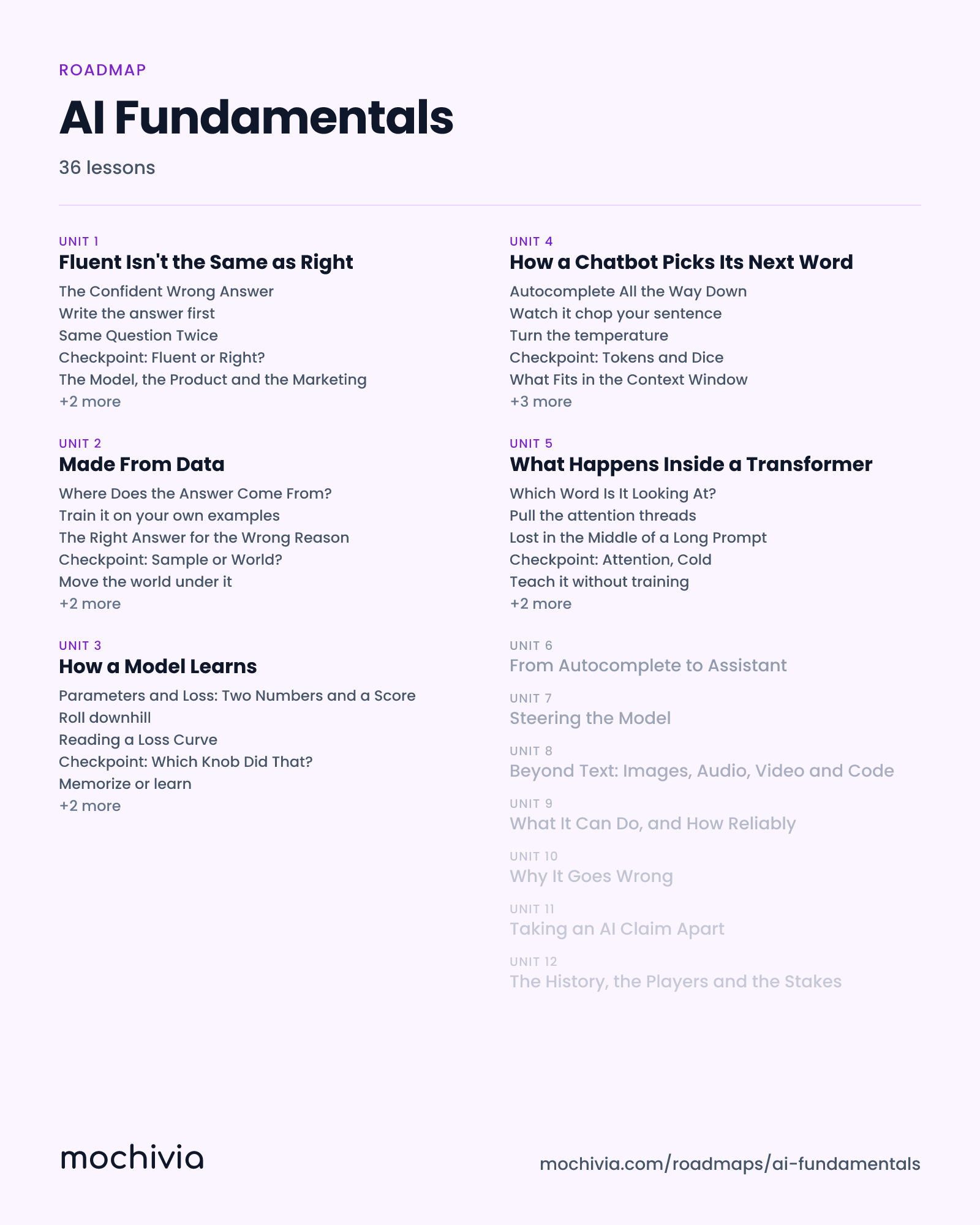
AI Fundamentals
Know what today's AI can and can't do, and why — without taking anyone's word for it. Test a chatbot, read a model, take a claim apart.
36 lessons

Scan on iPhone
What you'll learn
Unit 1
Fluent Isn't the Same as Right
7 lessons
- The confident wrong answer
- The learner acts by writing their expected answer to five prompts they already know the answers to before running each against a live sandboxed model, and the model responds with its output, which the learner grades against their own written prediction.Exercise
- Same question twice
- Fluent or right coldChallenge
- The weight file and the wrapper
- The learner acts by toggling the wrapper layers around one live sandboxed model — system prompt, conversation memory, model swap — and re-running the same input through each configuration after committing a prediction, and the model responds with the output each configuration actually produces.Exercise
- Calibrated user check oneUnit review

Unit 2
Made From Data
7 lessons
- Where does the answer come from
- The learner acts by choosing which labeled examples enter a tiny live classifier's training set and committing a prediction of its behavior on unseen examples, and the model responds by refitting and showing what it now gets right and wrong on the examples it never saw.Exercise
- The horse that could count
- Sample or world coldChallenge
- The learner acts by sliding the deployment inputs of a tiny live fitted model away from its training distribution along one axis at a time after committing an accuracy prediction, and the model responds with its measured accuracy on the shifted inputs, curve by curve.Exercise
- The only honest test
- Made from data reviewUnit review
Unit 3
How a Model Learns
7 lessons
- Two numbers and a score
- The learner acts by setting the learning rate and stepping a live descent on a loss surface after committing a prediction of converge, overshoot or stall, and the model responds by tracing the path its parameters actually take down the surface.Exercise
- Reading the curve
- Which knob did thatChallenge
- The learner acts by choosing a tiny network's capacity and number of training epochs against a held-out split after committing a prediction of where the validation curve turns, and the model responds with live training and validation loss curves that diverge or track.Exercise
- The big run and the small one
- Learning by nudging reviewUnit review
Unit 4
How a Chatbot Picks Its Next Word
8 lessons
- Autocomplete all the way down
- The learner acts by typing text into a live tokenizer after committing a prediction of where the pieces fall and how many there are, and the model responds by showing the pieces it actually sees, their count, and their cost.Exercise
- The learner acts by setting temperature and top-p and re-running the same prompt against a live small model after predicting how the next-token distribution will change, and the model responds with its visible probability distribution and the continuation it actually sampled.Exercise
- Tokens and dice coldChallenge
- What fits in the window
- What it knows and when it stopped
- The learner acts by prompting a live model about real, rare, and invented entities after committing a prediction of confident-right, confident-wrong or hedged, and the model responds with its answer and its stated confidence for the learner to score against the truth.Exercise
- Calibrated user gateUnit review
Unit 5
What Happens Inside a Transformer
7 lessons
- Which word is it looking at
- The learner acts by editing the input tokens of a live small transformer after committing a prediction of where a chosen token's attention will land, and the model responds by redrawing its attention pattern with the weights visible.Exercise
- Lost in the middle
- Attention coldChallenge
- The learner acts by adding, removing, and reordering worked examples in the prompt of a live model after predicting its output on a held-out case, and the model responds with its output on that case, its weights untouched.Exercise
- Buying time to think
- Attention reviewUnit review
Explore more roadmaps
Investing & Trading
How markets, brokers, and order books actually work — and what the evidence says about trying to beat them. The trunk covers market mechanics, asset classes, leverage, and the risk math every participant needs; clusters dive into microstructure, execution, the retail arenas, sizing math, psychology, manias, and strategy evidence.
Personal Finance
The financial life skills nobody actually taught you — money psychology, budgeting, debt, credit, taxes, insurance, retirement accounts, and the math of financial independence. Walk the trunk and you have a system; pull on a cluster when something specific matters.
Music Theory
A working understanding of how music is built — the twelve-note system, intervals, scales, keys, chords, harmony, rhythm, and form. The trunk gives you the complete map from a single note to a finished song; clusters dive deep into modes, the circle of fifths, chord construction, progressions, rhythm, melody, and form.
Astronomy
A working mental model of the cosmos — how we actually know what we know (light, telescopes, spectra), what the solar system, stars, and galaxies are, how the universe began, and how the search for other worlds and life is going. The trunk gives you the full map; clusters dive into the naked-eye sky, observatories, the sun, the planets, black holes, cosmology, and alien worlds.
Neuroscience
A working understanding of how the brain actually works at the level of mechanism — neurons firing, chemicals crossing synapses, regions specializing, circuits adapting. The trunk takes you from a single cell's electrical signal up through brain anatomy, sensation, movement, plasticity, memory, sleep, and emotion; clusters dive into molecular signaling, the neurochemical systems, sensory neuroscience, plasticity and repair, the cognitive brain, the diseased brain, and the tools that let us see any of it.
Environmental Science
A coherent, mechanistic picture of how the Earth actually works as a coupled system — its biogeochemical cycles, climate physics, ecosystems, pollution pathways, and the leverage points where solutions live. The trunk gives you the throughline a working professional needs to reason about environmental claims; clusters dive into circulation, ecology, paleoclimate, climate modeling, pollution, energy, and mitigation.
Frequently asked questions
What does the AI Fundamentals roadmap cover?
5 units, starting with Fluent Isn't the Same as Right, Made From Data, How a Model Learns and How a Chatbot Picks Its Next Word, and 1 more.
Who is the AI Fundamentals roadmap for?
Written for Priya, 41, operations director; Marcus, 17, high-schooler; Dana, 63, retired teacher; Tomas, 29, backend developer; Amara, 34, technology journalist — and anyone arriving at AI from zero.
How do I start the AI Fundamentals roadmap?
Get the Mochivia app on the App Store and open this roadmap there.
Start AI Fundamentals
Scan on iPhone