Law
Legal literacy — how law actually works. The trunk gives you the operating system: where law comes from, how courts and precedent work, contracts, torts, property, criminal vs civil, and constitutional structure. Clusters dive into reading cases, contract mechanics, IP, your rights with police, and the startup legal toolkit.
1 pillars1 courses14 concepts
What you'll learn
Main Path
The mandatory throughline of this roadmap.
Law(14 concepts)
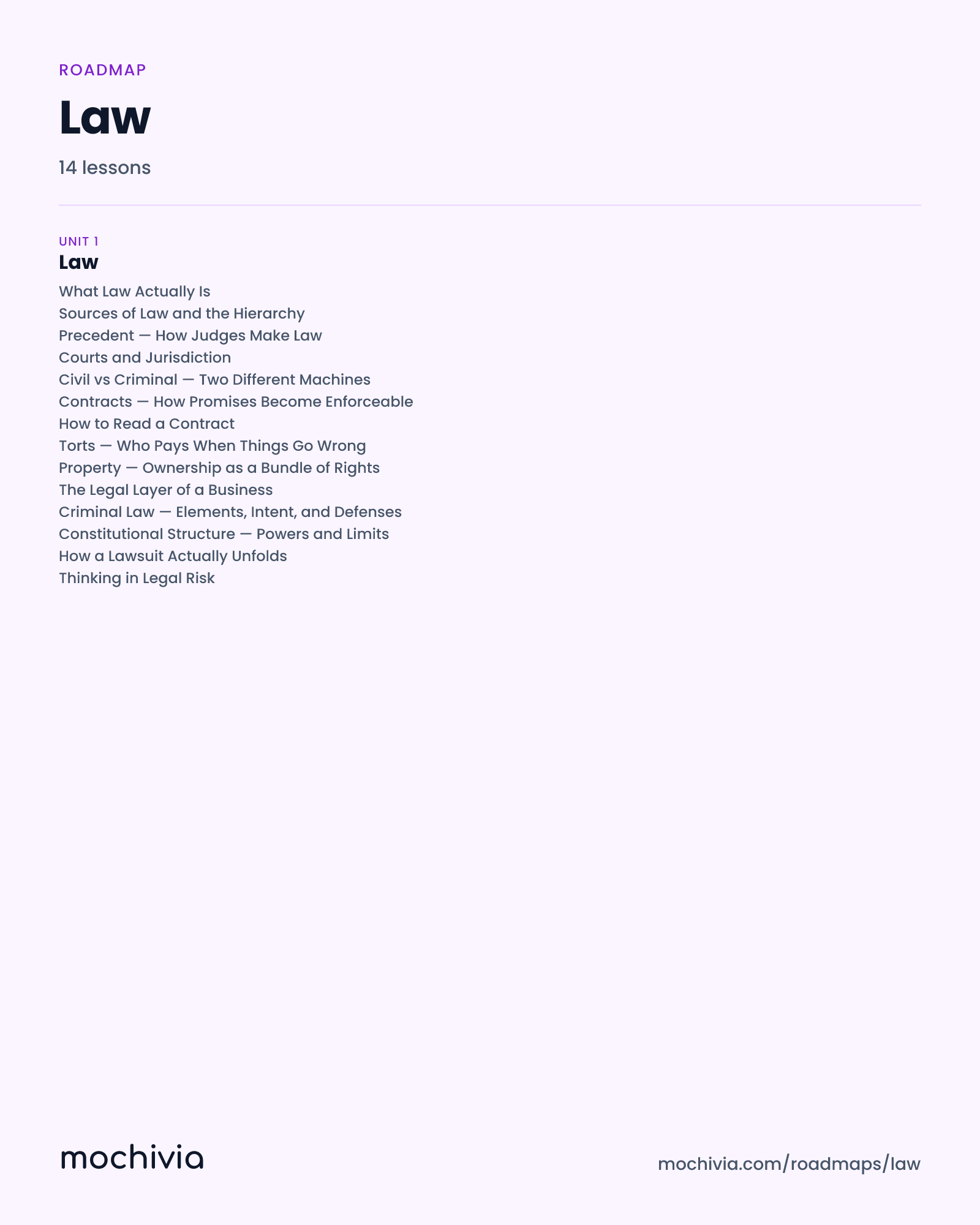
- What Law Actually Is
- Sources of Law and the Hierarchy
- Precedent — How Judges Make Law
- Courts and Jurisdiction
- Civil vs Criminal — Two Different Machines
- Contracts — How Promises Become Enforceable
- How to Read a Contract
- Torts — Who Pays When Things Go Wrong
- Property — Ownership as a Bundle of Rights
- The Legal Layer of a Business
- Criminal Law — Elements, Intent, and Defenses
- Constitutional Structure — Powers and Limits
- How a Lawsuit Actually Unfolds
- Thinking in Legal Risk
Explore more roadmaps
Probability & Statistics
A working understanding of probability and statistics — how to reason under uncertainty, turn data into claims, and recognize when those claims are honest. The trunk gives you the core vocabulary and the inference pipeline; clusters dive into Bayesian reasoning, frequentist theory, regression, stochastic processes, and experimental design.
History
A working understanding of human history — from the first hominids to the global world we live in now. The trunk walks the throughline most people never got: how civilizations actually emerge, why empires rise and fall, and how the modern world was made. Clusters dive into the cities, classical mind, slave trade, revolutions, world wars, and how historians actually do their job.
Psychology
A working understanding of psychology — what the science actually claims about how minds, brains, and behavior fit together. The trunk gives you the orientation a literate professional needs (how psychology knows what it knows, the brain behind behavior, learning, memory, decision-making, emotion, personality, social influence, development, pathology, and what therapy does); clusters dive into research methods, perception, cognition mechanics, social influence tactics, the field guide of disorders, applied behavioral science, and the psychology of everyday life.
AI Fundamentals
A non-technical curriculum that builds real understanding of AI — how it works, why it fails, and how to use it intelligently. No math, no code, just durable mental models that make you a confident, critical user of AI tools.
Music Theory
A working understanding of how music is built — the twelve-note system, intervals, scales, keys, chords, harmony, rhythm, and form. The trunk gives you the complete map from a single note to a finished song; clusters dive deep into modes, the circle of fifths, chord construction, progressions, rhythm, melody, and form.
Philosophy
A guided tour through philosophical thinking — how to reason carefully, evaluate arguments, navigate ethics, and engage with the great questions about knowledge, reality, mind, and society. The trunk gives you orientation across the whole field; clusters dive deep on logic, ethics, epistemology, metaphysics, mind, politics, and the history of ideas.
Frequently asked questions
What does the Law roadmap cover?
1 courses broken into 14 bite-size concepts, each taught as an interactive lesson with quizzes and spaced review.
Do I need prior experience to start?
No. The roadmap starts from fundamentals and builds in prerequisite order — each concept unlocks the next, so you're never thrown into material you haven't been prepared for. If you already know the basics, a placement check skips you ahead.
Is the Law roadmap free?
You can sign up free and start learning immediately. Mochivia's premium subscription unlocks unlimited daily lessons and the full roadmap depth.
Ready to start learning?
Sign up for free and start progressing through this roadmap with AI-powered lessons.
Get Started Free