Systematic Problem Solving
5 lessons

Scan on iPhone
What you'll learn

Unit 1
Problem Statements
5 lessons
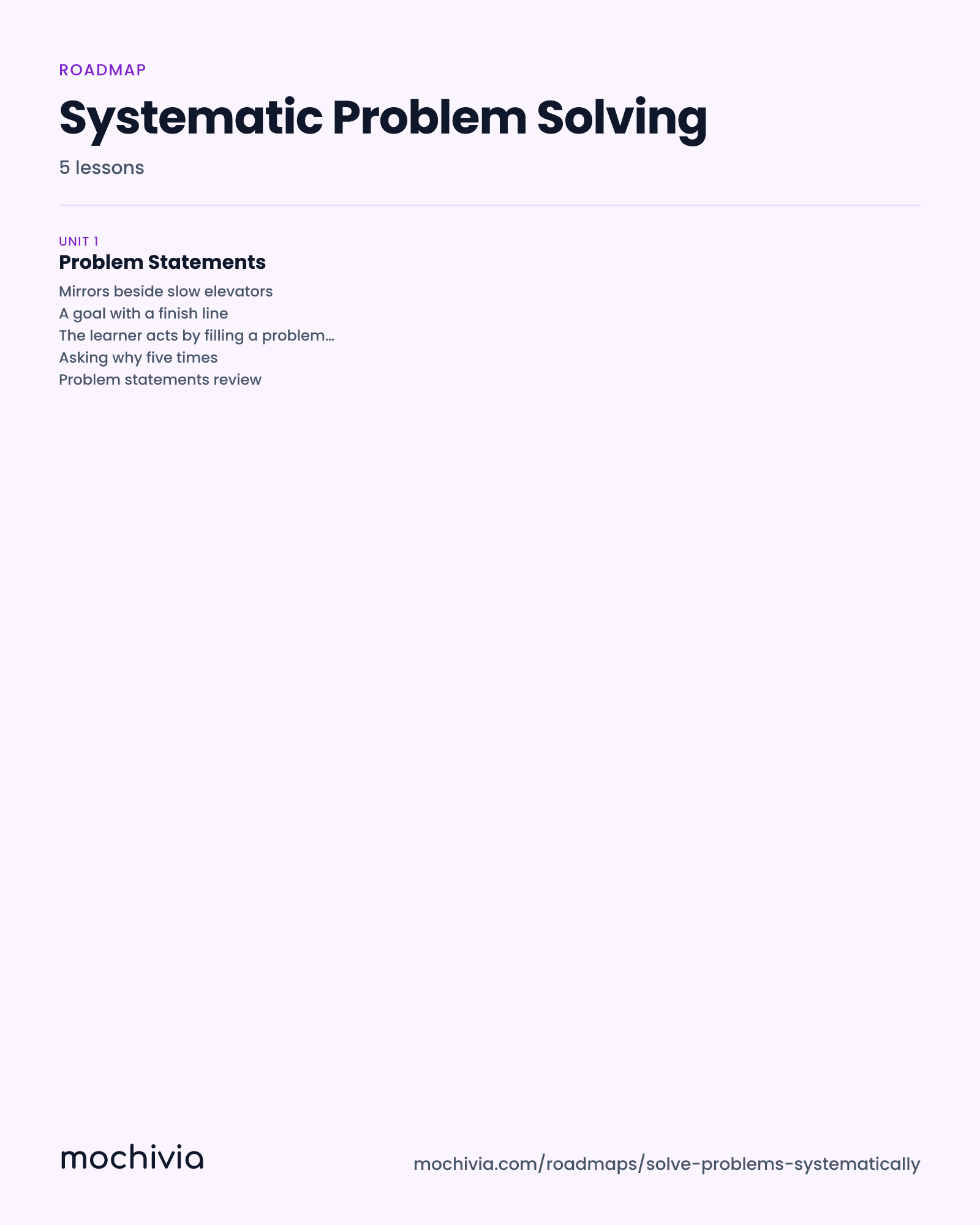
- Mirrors beside slow elevators
- A goal with a finish line
- The learner acts by filling a problem statement card for a vague complaint — striking the fix it assumes, choosing the need, then a measure, a now and a done — and the material responds by showing which parts of a finish line the card still lacks.Exercise
- Asking why five times
- Problem statements reviewUnit review
Explore more roadmaps
Neuroscience
A working understanding of how the brain actually works at the level of mechanism — neurons firing, chemicals crossing synapses, regions specializing, circuits adapting. The trunk takes you from a single cell's electrical signal up through brain anatomy, sensation, movement, plasticity, memory, sleep, and emotion; clusters dive into molecular signaling, the neurochemical systems, sensory neuroscience, plasticity and repair, the cognitive brain, the diseased brain, and the tools that let us see any of it.
Psychology
A working understanding of psychology — what the science actually claims about how minds, brains, and behavior fit together. The trunk gives you the orientation a literate professional needs (how psychology knows what it knows, the brain behind behavior, learning, memory, decision-making, emotion, personality, social influence, development, pathology, and what therapy does); clusters dive into research methods, perception, cognition mechanics, social influence tactics, the field guide of disorders, applied behavioral science, and the psychology of everyday life.
AI Fundamentals
A non-technical curriculum that builds real understanding of AI — how it works, why it fails, and how to use it intelligently. No math, no code, just durable mental models that make you a confident, critical user of AI tools.
Databases
Build the universal mental model that every database is implemented against — the relational model, schemas and keys, indexes, transactions, concurrency, PostgreSQL architecture, production operations, modeling patterns, and the modern data ecosystem (NoSQL, distributed SQL, warehouses, vectors, streaming).
Philosophy
A guided tour through philosophical thinking — how to reason carefully, evaluate arguments, navigate ethics, and engage with the great questions about knowledge, reality, mind, and society. The trunk gives you orientation across the whole field; clusters dive deep on logic, ethics, epistemology, metaphysics, mind, politics, and the history of ideas.
Software Development
A practical, 4-pillar skill track that takes you from zero to shipping. You will learn to think in code, master one language deeply (Python), turn scripts into real software with tests and version control, and put your work in front of users with a deploy, a database, and modern AI-assisted workflows. Deliberately narrower than a role-track CS degree: if the question is 'can I build and ship software,' this is the answer.
About 180 hours
Frequently asked questions
What does the Systematic Problem Solving roadmap cover?
1 unit: Problem Statements.
How do I start the Systematic Problem Solving roadmap?
Get the Mochivia app on the App Store and open this roadmap there.
Start Systematic Problem Solving
Scan on iPhone