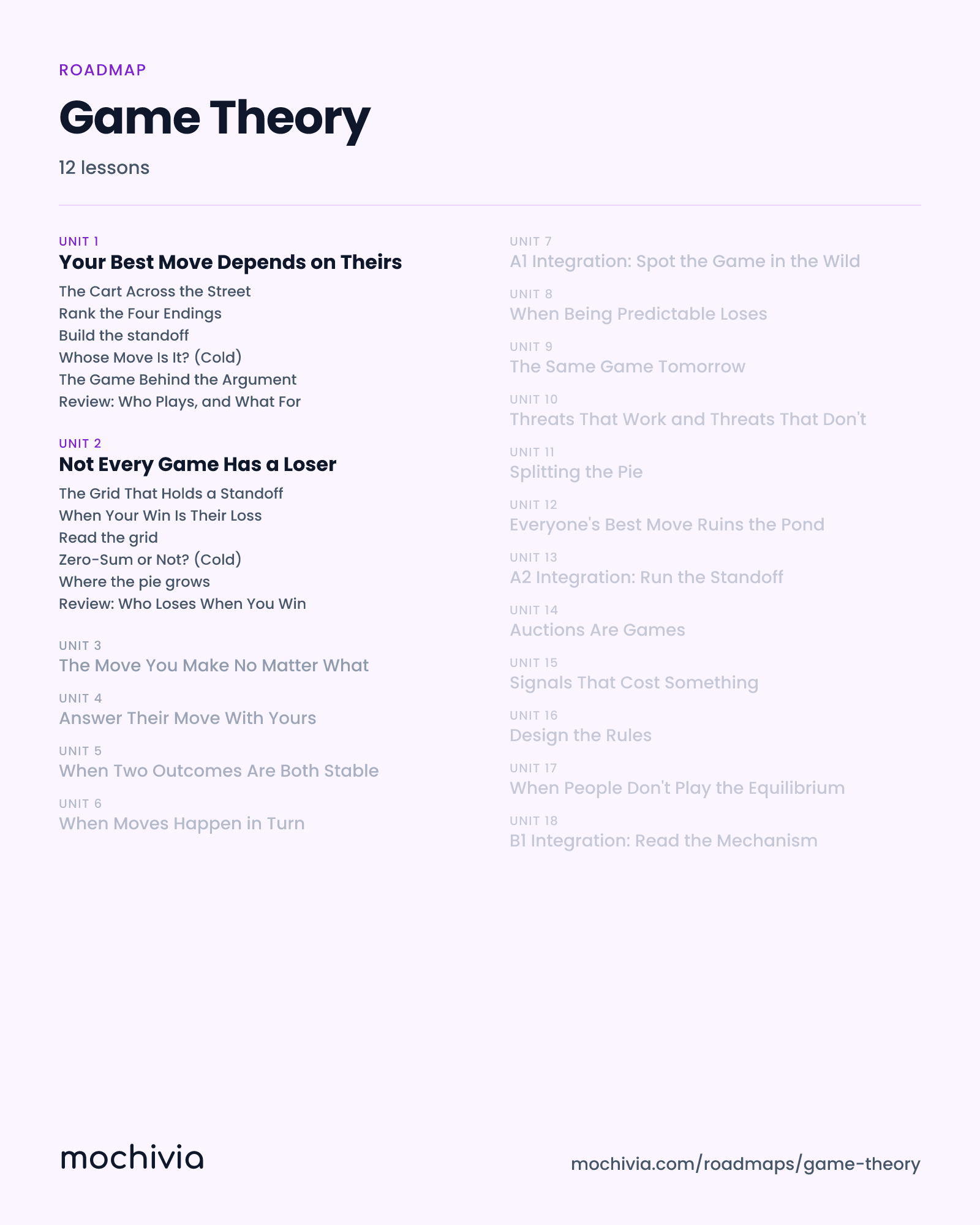
Game Theory
Turn rivals, negotiations and rule sheets into grids and trees, find the cell nobody leaves, and predict the other side's move — on a phone, minutes a day.
12 lessons

Scan on iPhone
What you'll learn

Unit 1
Your Best Move Depends on Theirs
6 lessons
- The Cart Across the Street
- Rank the Four Endings
- Build the standoffExercise
- Whose Move Is It? (Cold)Challenge
- The Game Behind the Argument
- Review: Who Plays, and What ForUnit review
Unit 2
Not Every Game Has a Loser
6 lessons
- The Grid That Holds a Standoff
- When Your Win Is Their Loss
- Read the gridExercise
- Zero-Sum or Not? (Cold)Challenge
- Where the pie growsExercise
- Review: Who Loses When You WinUnit review
Unit 3
The Move You Make No Matter What
Unit 4
Answer Their Move With Yours
Unit 5
When Two Outcomes Are Both Stable
Unit 6
When Moves Happen in Turn
Unit 7
A1 Integration: Spot the Game in the Wild
Unit 8
When Being Predictable Loses
Unit 9
The Same Game Tomorrow
Unit 10
Threats That Work and Threats That Don't
Unit 11
Splitting the Pie
Unit 12
Everyone's Best Move Ruins the Pond
Unit 13
A2 Integration: Run the Standoff
Unit 14
Auctions Are Games
Unit 15
Signals That Cost Something
Unit 16
Design the Rules
Unit 17
When People Don't Play the Equilibrium
Unit 18
B1 Integration: Read the Mechanism
Explore more roadmaps
Machine Learning
How machine learning actually works — from learning-as-optimization through the classical toolkit to deep learning and foundation models. The depth step after AI Fundamentals: real mechanics, no code or graduate math required.
AI & Machine Learning
A comprehensive, 3-pillar curriculum that builds durable understanding of artificial intelligence and machine learning — from the mathematical foundations and classical algorithms, through modern deep learning architectures, to the societal implications of deploying AI in the real world. Emphasizes timeless principles over transient tools so knowledge remains valuable as the field evolves.
About 1000 hours
AI Fundamentals
A non-technical curriculum that builds real understanding of AI — how it works, why it fails, and how to use it intelligently. No math, no code, just durable mental models that make you a confident, critical user of AI tools.
Blockchain & Web3
A working understanding of blockchain and Web3 — what these systems actually are, why they were built, and how the pieces (wallets, consensus, smart contracts, tokens, DeFi, NFTs, DAOs) fit together. The trunk gives you the orientation to follow any crypto conversation; clusters dive into cryptography, custody, consensus, smart-contract engineering, DeFi mechanics, NFTs/DAOs, and building dApps.
Personal Finance
The financial life skills nobody actually taught you — money psychology, budgeting, debt, credit, taxes, insurance, retirement accounts, and the math of financial independence. Walk the trunk and you have a system; pull on a cluster when something specific matters.
Databases
Build the universal mental model that every database is implemented against — the relational model, schemas and keys, indexes, transactions, concurrency, PostgreSQL architecture, production operations, modeling patterns, and the modern data ecosystem (NoSQL, distributed SQL, warehouses, vectors, streaming).
Frequently asked questions
What does the Game Theory roadmap cover?
2 units: Your Best Move Depends on Theirs and Not Every Game Has a Loser.
Who is the Game Theory roadmap for?
Written for Nadia, 38, whose rival cart just cut its price; Theo, 20, poker-curious; Mei, 34, renegotiating a vendor contract; Raúl, 52, reading the news; Yuki, 27, who wants Nash stated plainly.
How do I start the Game Theory roadmap?
Get the Mochivia app on the App Store and open this roadmap there.
Start Game Theory
Scan on iPhone