Think Probabilistically
18 lessons

Scan on iPhone
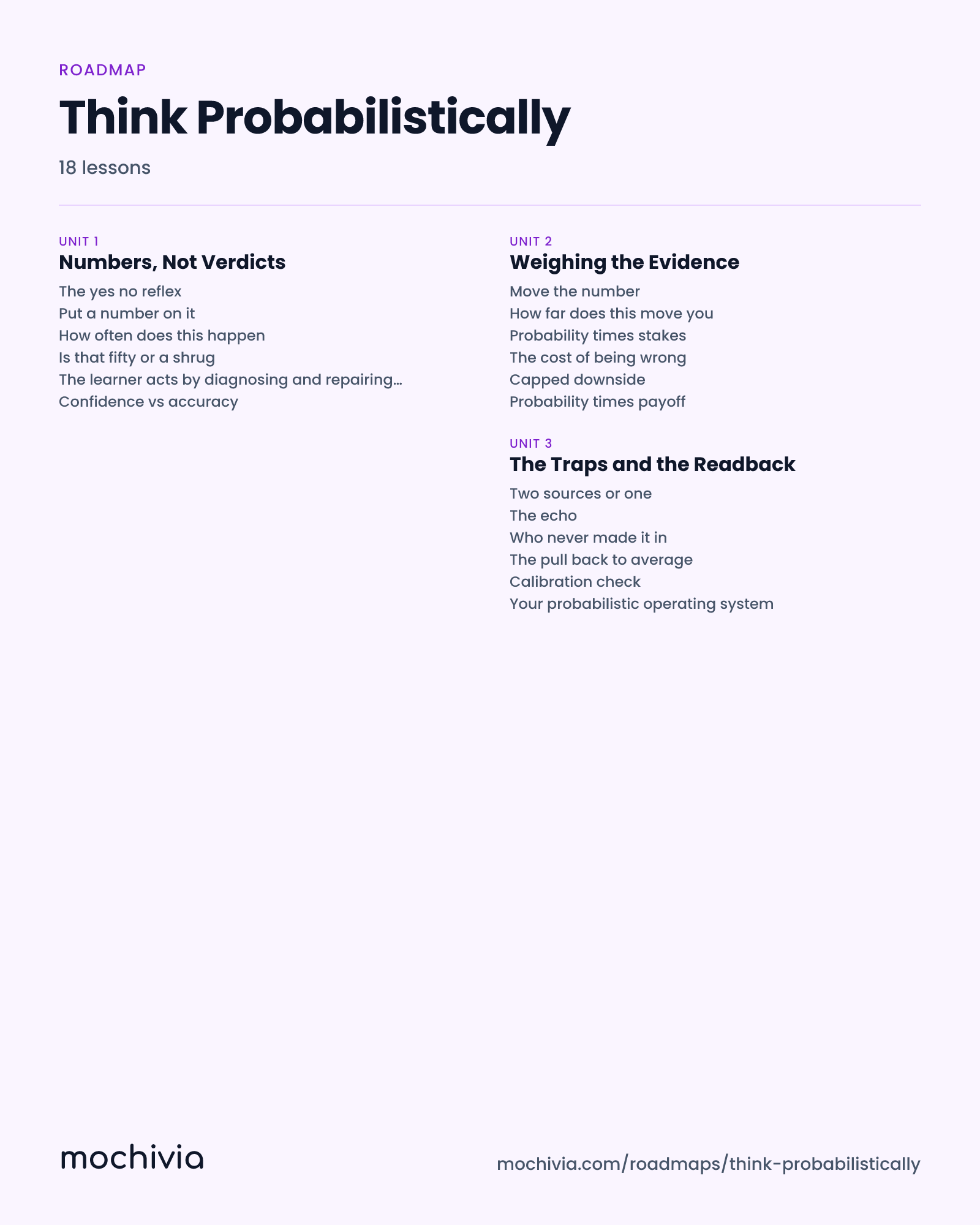
What you'll learn
Unit 1
Numbers, Not Verdicts
6 lessons
- The yes no reflex
- Put a number on it
- How often does this happen
- Is that fifty or a shrugChallenge
- The learner acts by diagnosing and repairing six draft predictions in a fortnight ledger — finding the verdict, the missing deadline and the uncheckable claim, then supplying the line, the date and their own number — and the ledger responds by striking each defect, marking each repaired row sealed, and holding its result column open for the days ahead.Exercise
- Confidence vs accuracyUnit review

Unit 2
Weighing the Evidence
6 lessons
- Move the number
- How far does this move youChallenge
- Probability times stakes
- The cost of being wrong
- Capped downside
- Probability times payoffUnit review

Unit 3
The Traps and the Readback
6 lessons
- Two sources or one
- The echo
- Who never made it in
- The pull back to average
- Calibration checkChallenge
- Your probabilistic operating systemUnit review
Explore more roadmaps
Mathematics
A working understanding of mathematics — the universal language scientists, engineers, and quants use to describe the world. The trunk gives you the throughline from how mathematicians think to how math models reality; clusters dive into proof, trig, calculus mechanics, advanced linear algebra, number theory and cryptography, probability, stochastic processes, and the foundational limits of math itself.
Algebra & Precalculus
The foundation curriculum that prepares you for any university-level math course — calculus, linear algebra, discrete math, statistics. Builds symbolic fluency from variables and equations through functions, polynomials, exponentials, trigonometry, and the proof and set-theory groundwork that modern mathematics rests on.
AI Fundamentals
A non-technical curriculum that builds real understanding of AI — how it works, why it fails, and how to use it intelligently. No math, no code, just durable mental models that make you a confident, critical user of AI tools.
AI & Machine Learning
A comprehensive, 3-pillar curriculum that builds durable understanding of artificial intelligence and machine learning — from the mathematical foundations and classical algorithms, through modern deep learning architectures, to the societal implications of deploying AI in the real world. Emphasizes timeless principles over transient tools so knowledge remains valuable as the field evolves.
About 1000 hours
Sales
A working understanding of the craft of selling — buyer psychology, discovery, qualification, objection handling, negotiation, and pipeline math. The trunk walks one complete deal motion from prospect to close to expansion; clusters dive into outbound mechanics, discovery frameworks, objection playbooks, negotiation, founder-led sales, and enterprise deals.
Economics
A working understanding of how economies actually behave — how scarcity drives choice, how markets allocate resources (and fail to), how money and policy steer the macroeconomy, and how trade, behavior, and institutions shape long-run prosperity. The trunk gives you the throughline a literate citizen needs; clusters dive into elasticity, market failures, consumer/producer theory, monetary and fiscal policy, trade policy, behavioral finance, and economic history.
Frequently asked questions
What does the Think Probabilistically roadmap cover?
3 units: Numbers, Not Verdicts, Weighing the Evidence and The Traps and the Readback.
How do I start the Think Probabilistically roadmap?
Get the Mochivia app on the App Store and open this roadmap there.
Start Think Probabilistically
Scan on iPhone