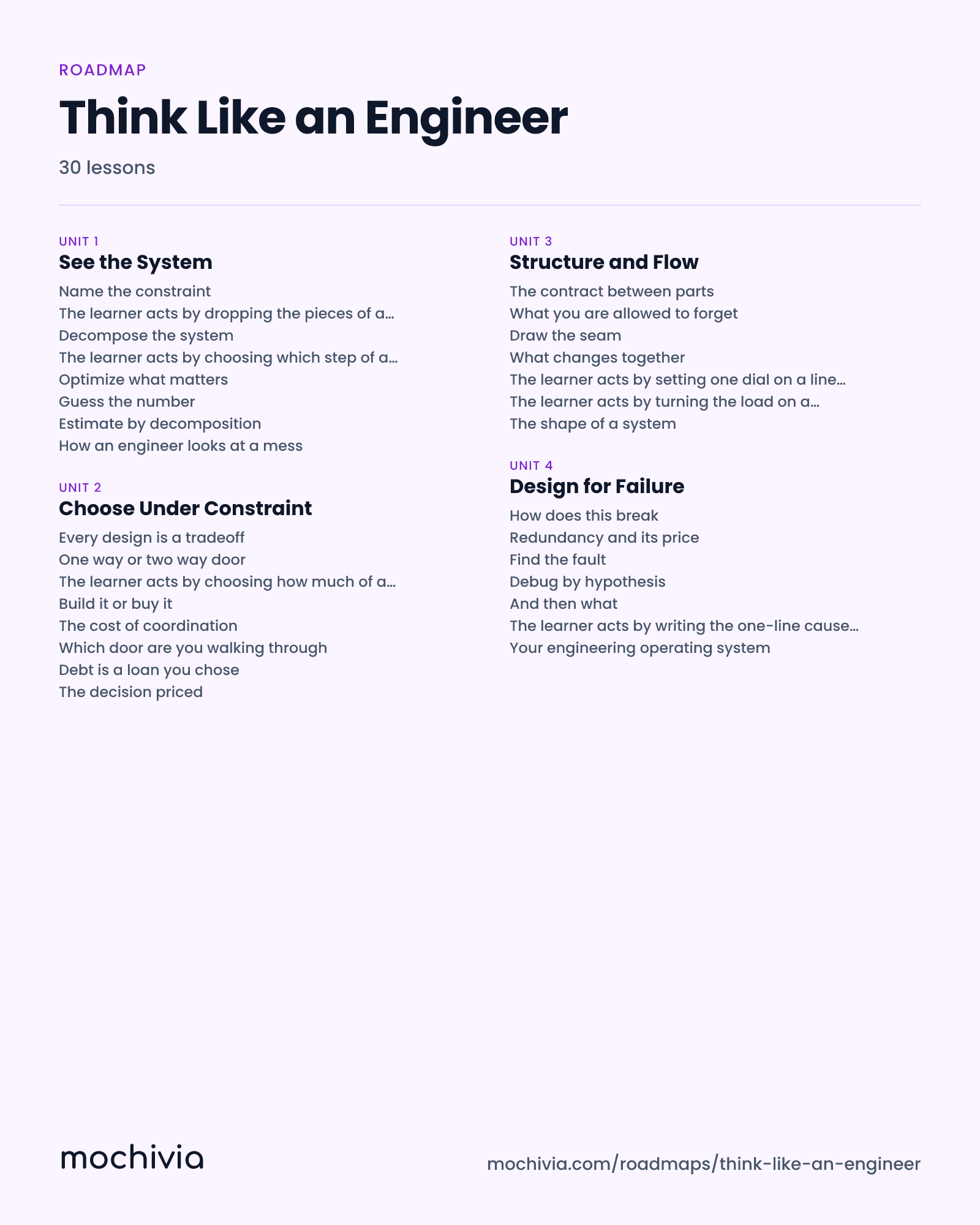
Think Like an Engineer
See any mess as a system: cut it into parts, name the tradeoffs, draw clean handoffs, and ask how a design fails before you ask whether it works.
30 lessons

Scan on iPhone
What you'll learn
Unit 1
See the System
8 lessons
- Name the constraint
- The learner acts by dropping the pieces of a system they actually deal with into three columns — what goes in, what happens to it, what comes out — and the model responds by redrawing their placement as a flow, flagging every piece that has no input feeding it and every output nothing produces, so the holes in their own picture become visible before any principle is stated.Exercise
- Decompose the system
- The learner acts by choosing which step of a real line of their own — their morning, a queue they stand in, a process they run — to make twice as fast, and the model responds by re-running the whole line with their change in place and showing the total time barely move until the one governing step is the one they touched.Exercise
- Optimize what matters
- Guess the numberChallenge
- Estimate by decomposition
- How an engineer looks at a messUnit review

Unit 2
Choose Under Constraint
8 lessons
- Every design is a tradeoff
- One way or two way door
- The learner acts by choosing how much of a broken system to replace — a patch, a part, or the whole thing — and the model responds by charging them for everything they touched in effort and in new risk, then testing whether the smallest option they passed over would have held anyway.Exercise
- Build it or buy it
- The cost of coordination
- Which door are you walking throughChallenge
- Debt is a loan you chose
- The decision pricedUnit review

Unit 3
Structure and Flow
7 lessons
- The contract between parts
- What you are allowed to forget
- Draw the seamChallenge
- What changes together
- The learner acts by setting one dial on a line they run themselves — how many things go into a single run — and the model responds with the two numbers that dial moves in opposite directions: how long the person at the front waits, and how many get through in an hour, so every setting they try buys one number by spending the other.Exercise
- The learner acts by turning the load on a system of their own up by ten, then a hundred, then a thousand, predicting at each step which part gives way first and choosing what to do about it, and the model responds by running the numbers for every part and showing which one actually gave way, how far off the prediction was, and what the patch buys before the next turn of the dial.Exercise
- The shape of a systemUnit review
Unit 4
Design for Failure
7 lessons
- How does this break
- Redundancy and its price
- Find the faultChallenge
- Debug by hypothesis
- And then what
- The learner acts by writing the one-line cause of a failure they actually had this month and then answering 'and what made that possible?' three more times, and the model responds by marking which of their four answers name a person and which name a system, and handing back the first answer that a change could actually be attached to.Exercise
- Your engineering operating systemUnit review
Explore more roadmaps
History
A working understanding of human history — from the first hominids to the global world we live in now. The trunk walks the throughline most people never got: how civilizations actually emerge, why empires rise and fall, and how the modern world was made. Clusters dive into the cities, classical mind, slave trade, revolutions, world wars, and how historians actually do their job.
Law
Legal literacy — how law actually works. The trunk gives you the operating system: where law comes from, how courts and precedent work, contracts, torts, property, criminal vs civil, and constitutional structure. Clusters dive into reading cases, contract mechanics, IP, your rights with police, and the startup legal toolkit.
Psychology
A working understanding of psychology — what the science actually claims about how minds, brains, and behavior fit together. The trunk gives you the orientation a literate professional needs (how psychology knows what it knows, the brain behind behavior, learning, memory, decision-making, emotion, personality, social influence, development, pathology, and what therapy does); clusters dive into research methods, perception, cognition mechanics, social influence tactics, the field guide of disorders, applied behavioral science, and the psychology of everyday life.
Philosophy
A guided tour through philosophical thinking — how to reason carefully, evaluate arguments, navigate ethics, and engage with the great questions about knowledge, reality, mind, and society. The trunk gives you orientation across the whole field; clusters dive deep on logic, ethics, epistemology, metaphysics, mind, politics, and the history of ideas.
Game Theory
A working understanding of game theory — the study of how rational agents make decisions when outcomes depend on each other's choices. The trunk gives you the core solution concepts and vocabulary; clusters dive into auctions, bargaining, evolutionary games, mechanism design, and where the rational-actor model fails.
Investing & Trading
How markets, brokers, and order books actually work — and what the evidence says about trying to beat them. The trunk covers market mechanics, asset classes, leverage, and the risk math every participant needs; clusters dive into microstructure, execution, the retail arenas, sizing math, psychology, manias, and strategy evidence.
Frequently asked questions
What does the Think Like an Engineer roadmap cover?
4 units: See the System, Choose Under Constraint, Structure and Flow and Design for Failure.
Who is the Think Like an Engineer roadmap for?
Written for Dana, 34, running operations at a forty-person company; Theo, 19, a computer-science student; Marisol, 52, managing a clinic that runs late every day — and anyone who wants an engineer's way of seeing.
How do I start the Think Like an Engineer roadmap?
Get the Mochivia app on the App Store and open this roadmap there.
Start Think Like an Engineer
Scan on iPhone