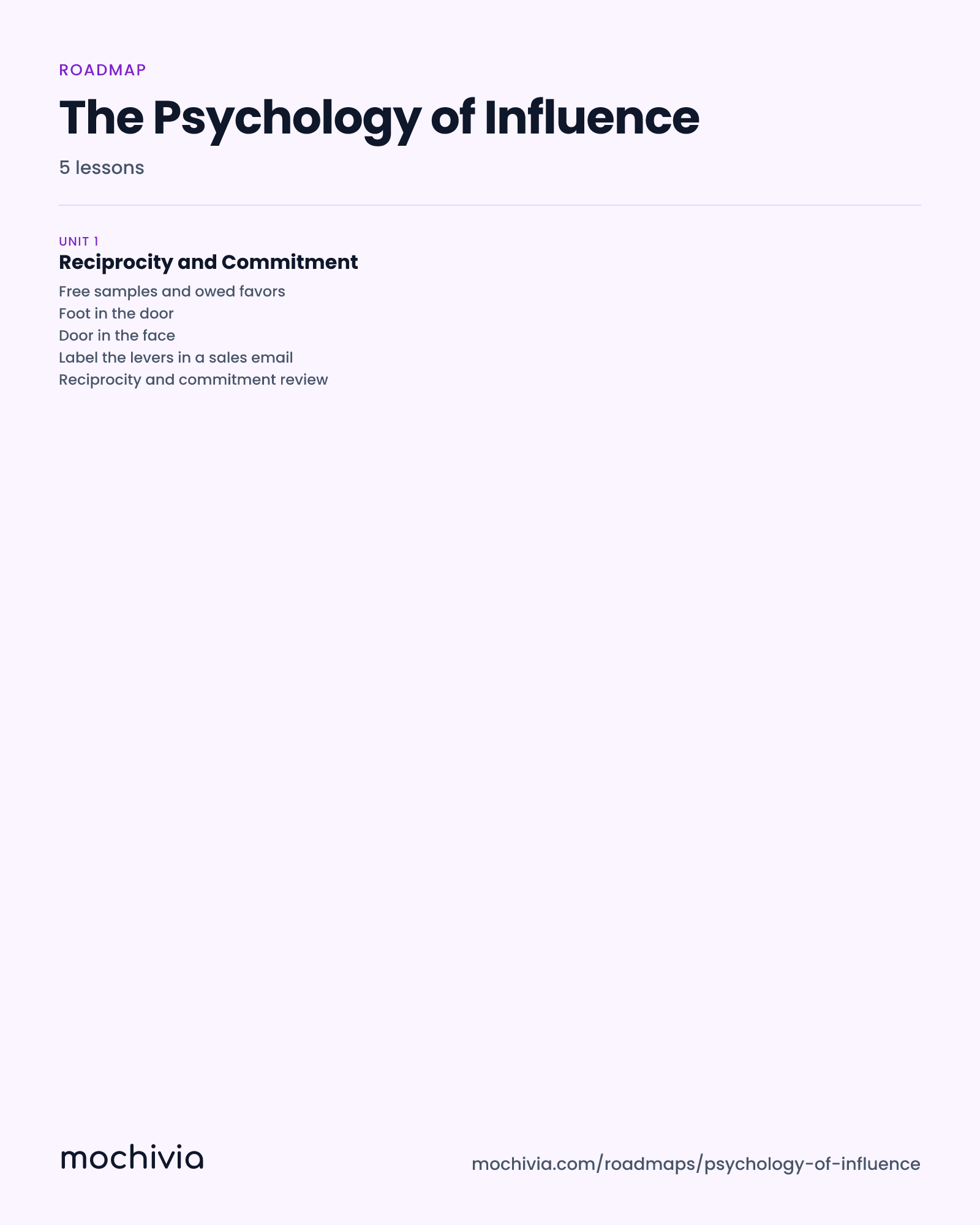
The Psychology of Influence
5 lessons

Scan on iPhone
What you'll learn

Unit 1
Reciprocity and Commitment
5 lessons
- Free samples and owed favors
- Foot in the door
- Door in the face
- Label the levers in a sales emailExercise
- Reciprocity and commitment reviewUnit review
Explore more roadmaps
Software Development
A practical, 4-pillar skill track that takes you from zero to shipping. You will learn to think in code, master one language deeply (Python), turn scripts into real software with tests and version control, and put your work in front of users with a deploy, a database, and modern AI-assisted workflows. Deliberately narrower than a role-track CS degree: if the question is 'can I build and ship software,' this is the answer.
About 180 hours
Natural Science
A working understanding of the natural world — what science is, how matter and energy behave, how life persists and changes, and how Earth and the cosmos fit together. The trunk gives you a single coherent throughline across physics, chemistry, biology, and earth/space science; clusters dive into experimental design, mechanics, thermodynamics, electromagnetism, modern physics, genetics, ecology, and climate.
Discrete Mathematics
A working understanding of discrete mathematics — the math of countable, structural objects: sets, logic, counting, graphs, integers, algorithms. The trunk gives you the toolkit; clusters dive into combinatorics, graph algorithms, number theory, logic and computation, cryptography, and information theory.
Sales
A working understanding of the craft of selling — buyer psychology, discovery, qualification, objection handling, negotiation, and pipeline math. The trunk walks one complete deal motion from prospect to close to expansion; clusters dive into outbound mechanics, discovery frameworks, objection playbooks, negotiation, founder-led sales, and enterprise deals.
Psychology
A working understanding of psychology — what the science actually claims about how minds, brains, and behavior fit together. The trunk gives you the orientation a literate professional needs (how psychology knows what it knows, the brain behind behavior, learning, memory, decision-making, emotion, personality, social influence, development, pathology, and what therapy does); clusters dive into research methods, perception, cognition mechanics, social influence tactics, the field guide of disorders, applied behavioral science, and the psychology of everyday life.
Philosophy
A guided tour through philosophical thinking — how to reason carefully, evaluate arguments, navigate ethics, and engage with the great questions about knowledge, reality, mind, and society. The trunk gives you orientation across the whole field; clusters dive deep on logic, ethics, epistemology, metaphysics, mind, politics, and the history of ideas.
Frequently asked questions
What does the The Psychology of Influence roadmap cover?
1 unit: Reciprocity and Commitment.
How do I start the The Psychology of Influence roadmap?
Get the Mochivia app on the App Store and open this roadmap there.
Start The Psychology of Influence
Scan on iPhone