Based on the role Frontend Developer
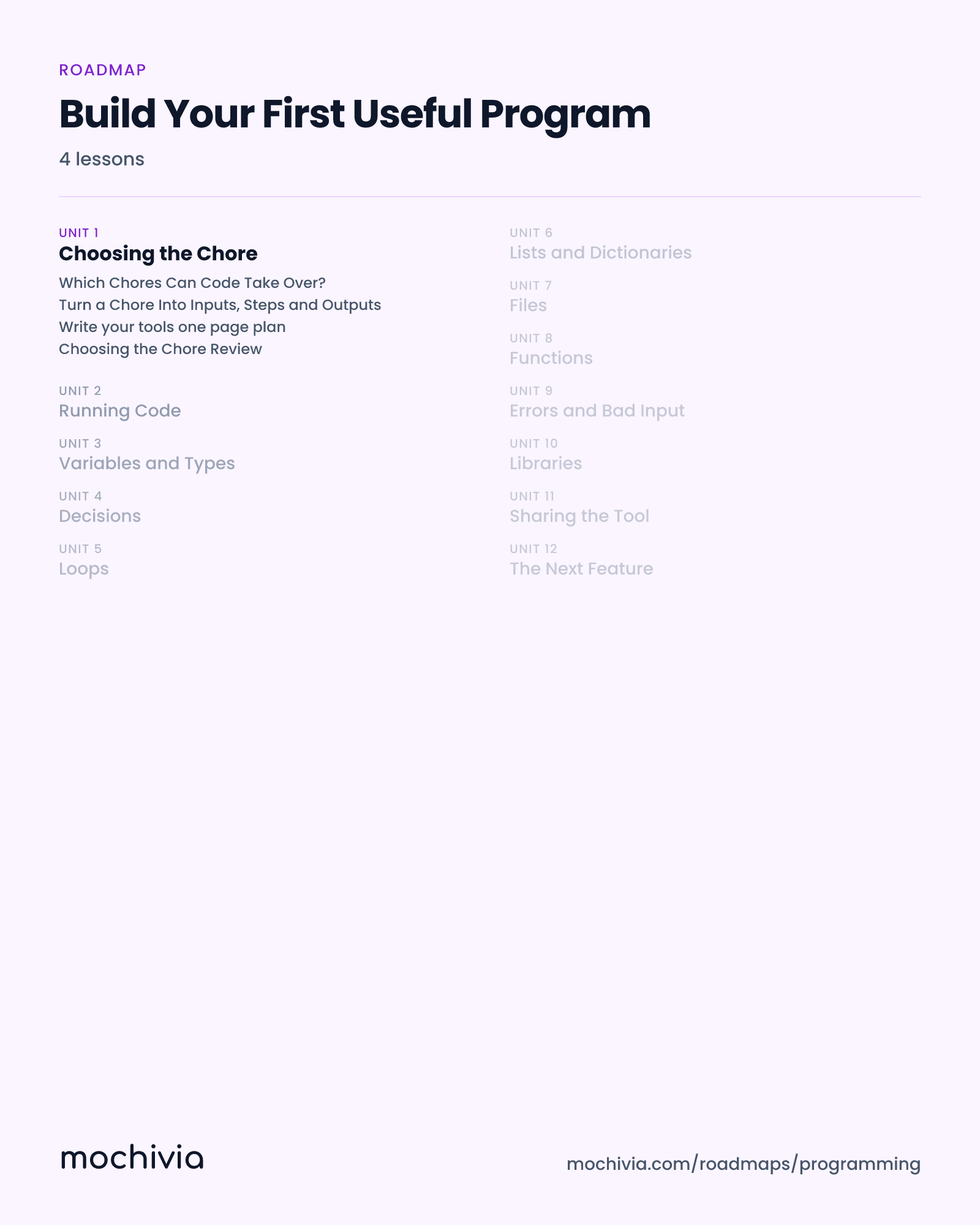
Build Your First Useful Program
4 lessons

Scan on iPhone
What you'll learn

Unit 1
Choosing the Chore
4 lessons
- Which Chores Can Code Take Over?
- Turn a Chore Into Inputs, Steps and Outputs
- Write your tools one page planExercise
- Choosing the Chore ReviewUnit review
Unit 2
Running Code
Unit 3
Variables and Types
Unit 4
Decisions
Unit 5
Loops
Unit 6
Lists and Dictionaries
Unit 7
Files
Unit 8
Functions
Unit 9
Errors and Bad Input
Unit 10
Libraries
Unit 11
Sharing the Tool
Unit 12
The Next Feature
Explore more roadmaps
Music Theory
A working understanding of how music is built — the twelve-note system, intervals, scales, keys, chords, harmony, rhythm, and form. The trunk gives you the complete map from a single note to a finished song; clusters dive deep into modes, the circle of fifths, chord construction, progressions, rhythm, melody, and form.
Software Development
A practical, 4-pillar skill track that takes you from zero to shipping. You will learn to think in code, master one language deeply (Python), turn scripts into real software with tests and version control, and put your work in front of users with a deploy, a database, and modern AI-assisted workflows. Deliberately narrower than a role-track CS degree: if the question is 'can I build and ship software,' this is the answer.
About 180 hours
Mathematics
A working understanding of mathematics — the universal language scientists, engineers, and quants use to describe the world. The trunk gives you the throughline from how mathematicians think to how math models reality; clusters dive into proof, trig, calculus mechanics, advanced linear algebra, number theory and cryptography, probability, stochastic processes, and the foundational limits of math itself.
Discrete Mathematics
A working understanding of discrete mathematics — the math of countable, structural objects: sets, logic, counting, graphs, integers, algorithms. The trunk gives you the toolkit; clusters dive into combinatorics, graph algorithms, number theory, logic and computation, cryptography, and information theory.
Neuroscience
A working understanding of how the brain actually works at the level of mechanism — neurons firing, chemicals crossing synapses, regions specializing, circuits adapting. The trunk takes you from a single cell's electrical signal up through brain anatomy, sensation, movement, plasticity, memory, sleep, and emotion; clusters dive into molecular signaling, the neurochemical systems, sensory neuroscience, plasticity and repair, the cognitive brain, the diseased brain, and the tools that let us see any of it.
Psychology
A working understanding of psychology — what the science actually claims about how minds, brains, and behavior fit together. The trunk gives you the orientation a literate professional needs (how psychology knows what it knows, the brain behind behavior, learning, memory, decision-making, emotion, personality, social influence, development, pathology, and what therapy does); clusters dive into research methods, perception, cognition mechanics, social influence tactics, the field guide of disorders, applied behavioral science, and the psychology of everyday life.
Frequently asked questions
What does the Build Your First Useful Program roadmap cover?
1 unit: Choosing the Chore.
How do I start the Build Your First Useful Program roadmap?
Get the Mochivia app on the App Store and open this roadmap there.
Start Build Your First Useful Program
Scan on iPhone