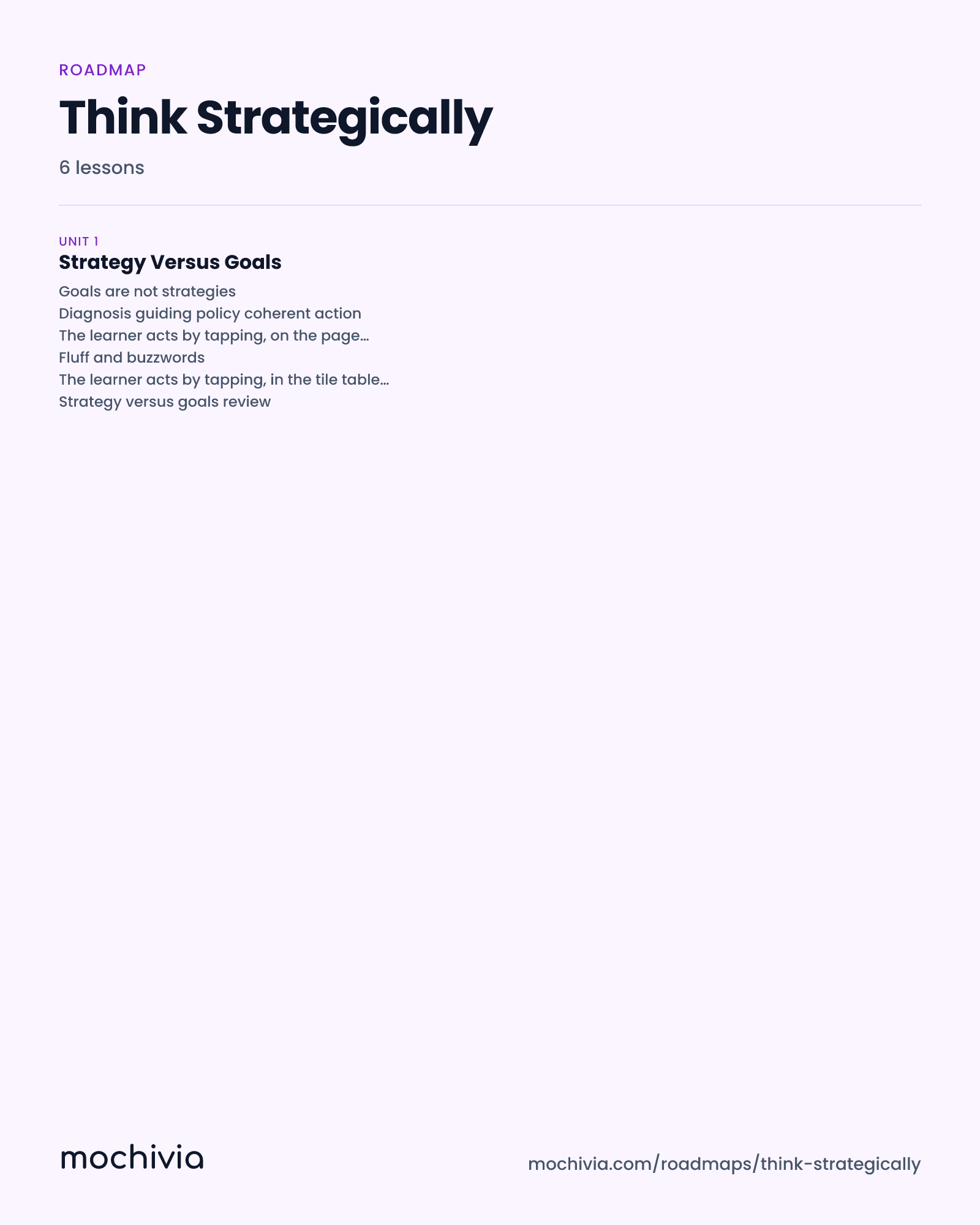
Think Strategically
6 lessons

Scan on iPhone
What you'll learn

Unit 1
Strategy Versus Goals
6 lessons
- Goals are not strategies
- Diagnosis guiding policy coherent action
- The learner acts by tapping, on the page draft, the candidate first line in each arena that names what stands in the way, and the material responds by docking that line into What we face and striking the goal line back off the page.Exercise
- Fluff and buzzwords
- The learner acts by tapping, in the tile table under the team page's What we face line, the tiles that name the obstacle's cause and what makes it hard, and the material responds by docking each kept tile with its job and striking goal, fluff and move tiles off the draft.Exercise
- Strategy versus goals reviewUnit review
Explore more roadmaps
Environmental Science
A coherent, mechanistic picture of how the Earth actually works as a coupled system — its biogeochemical cycles, climate physics, ecosystems, pollution pathways, and the leverage points where solutions live. The trunk gives you the throughline a working professional needs to reason about environmental claims; clusters dive into circulation, ecology, paleoclimate, climate modeling, pollution, energy, and mitigation.
Economics
A working understanding of how economies actually behave — how scarcity drives choice, how markets allocate resources (and fail to), how money and policy steer the macroeconomy, and how trade, behavior, and institutions shape long-run prosperity. The trunk gives you the throughline a literate citizen needs; clusters dive into elasticity, market failures, consumer/producer theory, monetary and fiscal policy, trade policy, behavioral finance, and economic history.
Music Theory
A working understanding of how music is built — the twelve-note system, intervals, scales, keys, chords, harmony, rhythm, and form. The trunk gives you the complete map from a single note to a finished song; clusters dive deep into modes, the circle of fifths, chord construction, progressions, rhythm, melody, and form.
Neuroscience
A working understanding of how the brain actually works at the level of mechanism — neurons firing, chemicals crossing synapses, regions specializing, circuits adapting. The trunk takes you from a single cell's electrical signal up through brain anatomy, sensation, movement, plasticity, memory, sleep, and emotion; clusters dive into molecular signaling, the neurochemical systems, sensory neuroscience, plasticity and repair, the cognitive brain, the diseased brain, and the tools that let us see any of it.
History
A working understanding of human history — from the first hominids to the global world we live in now. The trunk walks the throughline most people never got: how civilizations actually emerge, why empires rise and fall, and how the modern world was made. Clusters dive into the cities, classical mind, slave trade, revolutions, world wars, and how historians actually do their job.
Mathematics
A working understanding of mathematics — the universal language scientists, engineers, and quants use to describe the world. The trunk gives you the throughline from how mathematicians think to how math models reality; clusters dive into proof, trig, calculus mechanics, advanced linear algebra, number theory and cryptography, probability, stochastic processes, and the foundational limits of math itself.
Frequently asked questions
What does the Think Strategically roadmap cover?
1 unit: Strategy Versus Goals.
How do I start the Think Strategically roadmap?
Get the Mochivia app on the App Store and open this roadmap there.
Start Think Strategically
Scan on iPhone